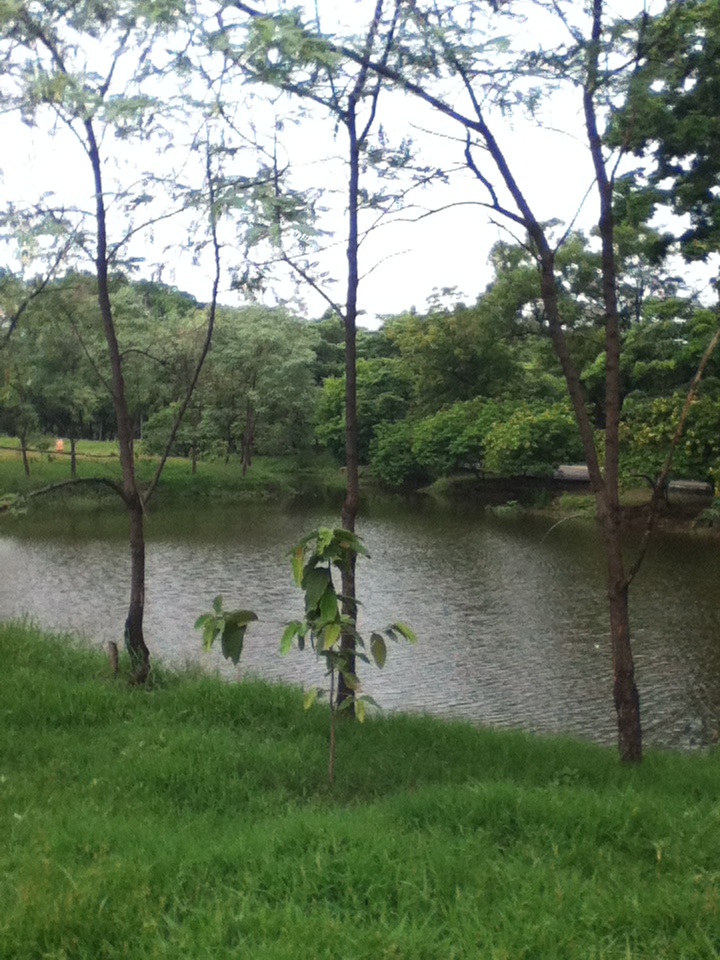
09/22/2012. 9:00 AM.
Start: GPS N 35, 46.463, W 78, 32.510
End: GPS N 35, 47.951, W 78, 32.451
This part of the Neuse River Trail runs north along the west bank of the Neuse River starting at Anderson Point Park, which is located at 20 Anderson Point Drive. The park itself is situated south of the Knightdale bypass (Hwy 264 or 54), and access to the trail from the park is by means of an overpass. However, there is another parking lot near the intersection of Anderson Point Dr. and Neuse View Dr that is much closer to the part of the trail that runs along the river. This parking lot also provides access to a canoe launch on the Neuse River. My outing began at this parking lot. There are plans to eventually connect Anderson Point Park to the Crabtree Creek Trail, but it appears that this project is not yet complete.
This trail is one that I had visited a couple of times before, back when I tended to go birding only once or twice a year. At the time I did not know it was part of the Capital Area Greenway system, and thought it was just an extension of Anderson Point Park. The trail is better marked now. This trail was the first place I ever saw a Red Headed Woodpecker, and it was not paved the last time I visited. The trail is now paved, seems to follow a somewhat different course than it did before (generally closer to the river's edge), and has two access points from across the river via footbridges. One of these appears to join up with a new trail called the Mingo Creek Trail, and the other leads to Loch Raven Parkway. I ended my outing for the day at the Loch Raven Parkway entrance, and will hopefully complete this part of the Neuse River Trail on my next outing.
Birds Seen Between Parking Lot and Mingo Creek Access Point:
Northern Cardinal: Visible from parking lot.
Northern Mockingbird: GPS N 35, 46.474, W 78, 32.573.
European Starling: Cluster of three birds on a high tension power line.
Mourning Dove: GPS N 35, 56.625, W 78, 32.331.
Birds Seen Between Mingo Creek Access Bridge and New Bern Ave. Overpass: See photo at left for the Mingo Creek Bridge.
American Crow: GPS N 35, 46.854, W 78, 32.282.
American Robin: Perched high in a tree.
Blue Jay: GPS N 35, 46.959, W 78, 32.266
Red Bellied Woodpecker: Same area as Blue Jay.
Canada Goose: GPS N 35, 47.399, W 78, 32.184. A flock of about 15-20 birds in flight.
The New Bern overpass is located at GPS N 35, 47.586, W 78, 32.357. Prior to reaching this overpass, there is a boardwalk under construction over what is probably at times a marshy area. Currently, trail users must follow a somewhat muddy path that diverts around the new construction. Presumably this boardwalk will be completed soon.
Birds Sighted Between New Bern Ave. and the Loch Raven Parkway Access Point:
Tufted Titmouse: GPS N 35, 47.680, W 78, 32.507.
Carolina Chickadee: In same trees with Titmice.
Gray Catbird: GPS N 35, 47.752, W 78, 32.566.
Brown Thrasher: GPS N 35, 47.791, W 78, 32.557.
Along this part of the trail, I did see two or three species that I was unable to identify. In one case, I saw a flash of yellow color but did not get to see the bird through my binoculars. In two others, they were species that I did not immediately recognize and I got only a brief look, not enough to make a firm identification. The vegetation was quite thick along the trail in many places, which made it difficult to get long looks at the birds. I suspect this would be a much better place to come in a few weeks when the trees have shed some of their leaves.
New Species Sighted on the Return Trip: I saw no new species on the return trip until I was almost back to the parking lot.
Turkey Vulture: GPS N 35, 46.456, W 78, 32.471. Two birds in flight.
This was a somewhat disappointing outing, as I only identified 14 species. None were new species for the Raleigh Greenway list. I remember my previous trips here being more productive. The poor showing could have something to do with the time of year, or it might relate to the new construction along this trail. Perhaps the wildlife has not completely adjusted to the changes in the trail yet. I hope to continue north and find the end of this trail on my next outing.
Reports the results of birding trips along the Capital Area Greenway in Raleigh, North Carolina. Includes addresses or GPS coordinates for access points to the Greenway, as well as names of species and GPS locations indicating where they were seen.
Sunday, September 30, 2012
Friday, September 14, 2012
Trail 27: Lake Lynn Trail
08/30/2012. 8:45 AM.
Start & End: GPS N 35, 53.265, W 78, 41.844
The Lake Lynn Trail is a 2.8 mile path that begins at the Lake Lynn Community Center (7921 Ray Road) and includes a loop of about 2.1 miles around Lake Lynn. The lake is artificial and was apparently set up to control flooding. The trail around the Lake is connected at its southern end to the Haresnipe Creek Trail, but appears to simply follow along Lynn Road west to Leesville Road, then south to West Millbrook Road. I have chosen not to report on trails that are primarily or exclusively roadside trails for this project.
There are two other public access points to the Lake Lynn Trail, one on Lynn Road, the other on Glenharden Drive, as well as several more from surrounding apartment complexes. This trail is the closest part of the Capital Area Greenway to my own home, so I have been here to walk a number of times before, but never with my binoculars. The trail is often busy, even on weekday mornings, and is a popular place for exercise.
The pathway leading from the community center parking lot to the Lake Lynn loop passes through a marshy area where deer are sometimes seen. The northern part of the lake is quite shallow and is a popular hangout for domesticated ducks and geese, as well as Great Blue Herons, Green Herons, and an abundance of turtles. Snapping turtles are also found occasionally in this area. The southern section of the lake has deeper water and fewer water birds, but most of this area is still lined with trees, providing the possibility of seeing other birds. My outing began at the Lake Lynn Community Center parking lot.
Birds Sighted Along Marshy Area Between Parking Lot and Lake:
The morning began a bit slowly, then picked up after about 9:15 AM. I returned along this section at the end of the outing and had much better luck at that time (see below).
Blue Jay: This bird was spotted in the parking lot.
Gray Catbird: GPS N 35, 53.220, W 78, 41.876.
Northern Cardinal: Same area as the Catbird.
Birds Sighted Along East Side of Lake Lynn Loop:
Mallard: GPS N 35, 53.038, W 78, 41.974. At least fifty were present.
Canada Goose: In same area with mallards.
Green Heron: GPS N 35, 53.022, W 78, 41.973. There were three of these out on the flats. I chatted with a photographer who told me there are six of these who frequent the lake. This is a new bird for the Raleigh Greenway List.
White Breasted Nuthatch: GPS N 35, 52.609, W 78, 41.828.
Hairy Woodpecker: In same area with the Nuthatch. Got a good look at the long beak and the dark stripe in front of the shoulder.
Song Sparrow: GPS N 35, 52.581, W 78, 41.807. Perched on a post near one of the apartment complexes.
Red Bellied Woodpecker: GPS N 35, 52.484, W 78, 41.799. Amid the pine trees on the grounds of an apartment complex.
Birds Sighted Along West Side of Lake Lynn Loop:
Mourning Dove: GPS N 35, 52.355, W 78, 41.789.
Northern Mockingbird: GPS N 35, 52.648, W 78, 42.064
Great Blue Heron: GPS N 35, 52.850, W 78, 42.064. This bird was perched in a tree near the boardwalk pictured at left. The photographer told me there are four of them who frequent the lake.
Belted Kingfisher: GPS N 35, 53.032, W 78, 42.037. I have seen this bird here a couple of times before as well. It seems to like to stand in a partly denuded tree on the north end of the lake on the east side. But the tree is only visible from the west side, near the northern end of the trail.
Birds Sighted On Return Path to Community Center Parking Lot:
Fish Crow: GPS N 35, 53.039, W 78, 41.975. Confirmed by sound of call.
Tufted Titmouse: GPS N 35, 53.175, W 78, 41.912. This one turned out to be a bit difficult to find.
Pileated Woodpecker: GPS N 35, 53.191, W 78, 41.903. This was probably the highlight of the day for me. I haven't seen one of these since my outing on the Neuse River Trail last winter, and I have never seen one at the park before. It did not stay long, but was nice to see.
Common Grackle: GPS N 35, 53.195, W 78, 41.902. Saw several of these moving through the swampy area.
Turkey Vulture: Saw two of these in flight from the parking lot.
I ended the outing with a total of 19 species for the day, and one new addition to the Capital Area Greenway List. That brings the total to 61 species since December of last year.
Start & End: GPS N 35, 53.265, W 78, 41.844
The Lake Lynn Trail is a 2.8 mile path that begins at the Lake Lynn Community Center (7921 Ray Road) and includes a loop of about 2.1 miles around Lake Lynn. The lake is artificial and was apparently set up to control flooding. The trail around the Lake is connected at its southern end to the Haresnipe Creek Trail, but appears to simply follow along Lynn Road west to Leesville Road, then south to West Millbrook Road. I have chosen not to report on trails that are primarily or exclusively roadside trails for this project.
There are two other public access points to the Lake Lynn Trail, one on Lynn Road, the other on Glenharden Drive, as well as several more from surrounding apartment complexes. This trail is the closest part of the Capital Area Greenway to my own home, so I have been here to walk a number of times before, but never with my binoculars. The trail is often busy, even on weekday mornings, and is a popular place for exercise.
The pathway leading from the community center parking lot to the Lake Lynn loop passes through a marshy area where deer are sometimes seen. The northern part of the lake is quite shallow and is a popular hangout for domesticated ducks and geese, as well as Great Blue Herons, Green Herons, and an abundance of turtles. Snapping turtles are also found occasionally in this area. The southern section of the lake has deeper water and fewer water birds, but most of this area is still lined with trees, providing the possibility of seeing other birds. My outing began at the Lake Lynn Community Center parking lot.
Birds Sighted Along Marshy Area Between Parking Lot and Lake:
The morning began a bit slowly, then picked up after about 9:15 AM. I returned along this section at the end of the outing and had much better luck at that time (see below).
Blue Jay: This bird was spotted in the parking lot.
Gray Catbird: GPS N 35, 53.220, W 78, 41.876.
Northern Cardinal: Same area as the Catbird.
Birds Sighted Along East Side of Lake Lynn Loop:
Mallard: GPS N 35, 53.038, W 78, 41.974. At least fifty were present.
Canada Goose: In same area with mallards.
Green Heron: GPS N 35, 53.022, W 78, 41.973. There were three of these out on the flats. I chatted with a photographer who told me there are six of these who frequent the lake. This is a new bird for the Raleigh Greenway List.
White Breasted Nuthatch: GPS N 35, 52.609, W 78, 41.828.
Hairy Woodpecker: In same area with the Nuthatch. Got a good look at the long beak and the dark stripe in front of the shoulder.
Song Sparrow: GPS N 35, 52.581, W 78, 41.807. Perched on a post near one of the apartment complexes.
Red Bellied Woodpecker: GPS N 35, 52.484, W 78, 41.799. Amid the pine trees on the grounds of an apartment complex.
Birds Sighted Along West Side of Lake Lynn Loop:
Mourning Dove: GPS N 35, 52.355, W 78, 41.789.
Northern Mockingbird: GPS N 35, 52.648, W 78, 42.064
Great Blue Heron: GPS N 35, 52.850, W 78, 42.064. This bird was perched in a tree near the boardwalk pictured at left. The photographer told me there are four of them who frequent the lake.
Belted Kingfisher: GPS N 35, 53.032, W 78, 42.037. I have seen this bird here a couple of times before as well. It seems to like to stand in a partly denuded tree on the north end of the lake on the east side. But the tree is only visible from the west side, near the northern end of the trail.
Birds Sighted On Return Path to Community Center Parking Lot:
Fish Crow: GPS N 35, 53.039, W 78, 41.975. Confirmed by sound of call.
Tufted Titmouse: GPS N 35, 53.175, W 78, 41.912. This one turned out to be a bit difficult to find.
Pileated Woodpecker: GPS N 35, 53.191, W 78, 41.903. This was probably the highlight of the day for me. I haven't seen one of these since my outing on the Neuse River Trail last winter, and I have never seen one at the park before. It did not stay long, but was nice to see.
Common Grackle: GPS N 35, 53.195, W 78, 41.902. Saw several of these moving through the swampy area.
Turkey Vulture: Saw two of these in flight from the parking lot.
I ended the outing with a total of 19 species for the day, and one new addition to the Capital Area Greenway List. That brings the total to 61 species since December of last year.
Wednesday, August 29, 2012
Trail 26: Marsh Creek Trail
08/23/2012. 8:20 AM.
Start: GPS N 35, 49.732, W 78, 35.985
End: GPS N 35, 49.352, W 78, 35.486
The Marsh Creek Trail intersects with both Ingram Drive and Glenraven Drive, but the easiest access point is from the parking lot for Brentwood Park. The Marsh Creek Trail runs along the eastern boundary of the park, then continues on a short distance beyond. A small bridge across the creek connects the trail to Glenraven Drive, and about 100 feet later, the trail comes to an abrupt end. There is room for an extension of the trail, and there is a vague footpath that continues on along the creekside, but the morning was wet and the grasses were fairly tall, so I did not explore it.
The morning started slow, with very few birds making an appearance in the open. During the first hour, I only saw four different species. After about 9:15 AM though, activity picked up and I began to see a nice variety of birds. The morning was partly cloudy and the temperature was in the low 70s when I arrived. It was mostly sunny by the time I left at 10:45 AM.
Birds Sighted During First Hour:
Ruby Throated Hummingbird: GPS N 35, 49.751, W 78, 35.890. I saw hummingbirds in three different places in the park and along the trail. Brentwood Park has a number of "islands" of flowering plants, which probably attract them.
Gray Catbird: GPS N 35, 49.765, W 78, 35.890. This bird was calling from a fairly dense line of bushes along the edge of the trail. I finally got a look at it when it briefly came to the ground.
Northern Cardinal: This bird, too, was being rather cryptic in the same set of bushes as the Grey Catbird. Later, a couple in the park told me that a large hawk likes to hang around the area, so maybe the birds have learned to stay hidden in the morning until they know the hawk is not around.
Tufted Titmouse: GPS N 35, 49.682, W 78, 35.851. I have not seen one of these for several outings now. In the winter, they were among the most common. I do think that I hear them from time to time, but they seem to be more cryptic in the summer.
New Species Sighted After 9:15 AM
Red Bellied Woodpecker: GPS N 35, 49.681, W 78, 35.915. I believe there were two of these, though I only saw one clearly enough to identify it. They were in the stand of trees toward the southern end of the park where the fenced in baseball diamond is located.
Carolina Chickadee: Same place as the woodpecker. I was also surprised at how few of these I saw, given their usual numbers.
Eastern Bluebird: GPS N 35, 49.707, W 78, 35.945. There was at least one adult and one juvenile in the park, perhaps more.
Blue Gray Gnatcatcher: GPS N 35, 49.704, W 78, 35.919. Two of these were seen in the brightly flowering trees along a path that cuts across the middle of the park.
American Crow: Saw this bird fly over when I was watching the Blue Gray Gnatcatchers.
House Finch: GPS N 35, 49.772, W 78, 35.946. Perched on fencing around one of the playing fields.
Blue Jay: GPS N 35, 49.824, W 78, 35.917. Saw at least three of these as they moved across the park on their way somewhere else.
Downy Woodpecker: GPS N 35, 49.608, W 78, 35.817. There was a mini-flurry of bird activity in this one spot, beginning with this woodpecker.
White Breasted Nuthatch: Same area as the woodpecker.
Possible White Eyed Vireo: This bird had a longish body and fairly long tail. The most distinctive thing about it was the golden yellow coloring along the shoulder area just under the wings, and some yellowish color along the tail. I saw it for only a few seconds, and could not get a positive identification from my books or iBird App. The White Eyed Vireo seems closest, but my experience with the juvenile Eastern Bluebird last outing means that it could be a juvenile of a species that normally has more yellow on the body in adulthood.
Black and White Warbler: GPS N 35, 49.615, W 78, 35.822. A new bird, both for the Raleigh Greenway list, and for my lifelist!
Northern Flicker: GPS N 35, 49.741, W 78, 35.940. Although I see one of these a lot in my backyard, I believe this is only the second time I have seen these while walking the Capital Area Greenways. Both of the individuals I saw had the telltale black moustache indicating that they were males. Perhaps a parent and maturing juvenile?
The total for this outing was 15 species, excluding the possible White Eyed Vireo. This outing brings the Capital Area Greenway list to 60 different species sighted.
Start: GPS N 35, 49.732, W 78, 35.985
End: GPS N 35, 49.352, W 78, 35.486
The Marsh Creek Trail intersects with both Ingram Drive and Glenraven Drive, but the easiest access point is from the parking lot for Brentwood Park. The Marsh Creek Trail runs along the eastern boundary of the park, then continues on a short distance beyond. A small bridge across the creek connects the trail to Glenraven Drive, and about 100 feet later, the trail comes to an abrupt end. There is room for an extension of the trail, and there is a vague footpath that continues on along the creekside, but the morning was wet and the grasses were fairly tall, so I did not explore it.
The morning started slow, with very few birds making an appearance in the open. During the first hour, I only saw four different species. After about 9:15 AM though, activity picked up and I began to see a nice variety of birds. The morning was partly cloudy and the temperature was in the low 70s when I arrived. It was mostly sunny by the time I left at 10:45 AM.
Birds Sighted During First Hour:
Ruby Throated Hummingbird: GPS N 35, 49.751, W 78, 35.890. I saw hummingbirds in three different places in the park and along the trail. Brentwood Park has a number of "islands" of flowering plants, which probably attract them.
Gray Catbird: GPS N 35, 49.765, W 78, 35.890. This bird was calling from a fairly dense line of bushes along the edge of the trail. I finally got a look at it when it briefly came to the ground.
Northern Cardinal: This bird, too, was being rather cryptic in the same set of bushes as the Grey Catbird. Later, a couple in the park told me that a large hawk likes to hang around the area, so maybe the birds have learned to stay hidden in the morning until they know the hawk is not around.
Tufted Titmouse: GPS N 35, 49.682, W 78, 35.851. I have not seen one of these for several outings now. In the winter, they were among the most common. I do think that I hear them from time to time, but they seem to be more cryptic in the summer.
New Species Sighted After 9:15 AM
Red Bellied Woodpecker: GPS N 35, 49.681, W 78, 35.915. I believe there were two of these, though I only saw one clearly enough to identify it. They were in the stand of trees toward the southern end of the park where the fenced in baseball diamond is located.
Carolina Chickadee: Same place as the woodpecker. I was also surprised at how few of these I saw, given their usual numbers.
Eastern Bluebird: GPS N 35, 49.707, W 78, 35.945. There was at least one adult and one juvenile in the park, perhaps more.
Blue Gray Gnatcatcher: GPS N 35, 49.704, W 78, 35.919. Two of these were seen in the brightly flowering trees along a path that cuts across the middle of the park.
American Crow: Saw this bird fly over when I was watching the Blue Gray Gnatcatchers.
House Finch: GPS N 35, 49.772, W 78, 35.946. Perched on fencing around one of the playing fields.
Blue Jay: GPS N 35, 49.824, W 78, 35.917. Saw at least three of these as they moved across the park on their way somewhere else.
Downy Woodpecker: GPS N 35, 49.608, W 78, 35.817. There was a mini-flurry of bird activity in this one spot, beginning with this woodpecker.
White Breasted Nuthatch: Same area as the woodpecker.
Possible White Eyed Vireo: This bird had a longish body and fairly long tail. The most distinctive thing about it was the golden yellow coloring along the shoulder area just under the wings, and some yellowish color along the tail. I saw it for only a few seconds, and could not get a positive identification from my books or iBird App. The White Eyed Vireo seems closest, but my experience with the juvenile Eastern Bluebird last outing means that it could be a juvenile of a species that normally has more yellow on the body in adulthood.
Northern Flicker: GPS N 35, 49.741, W 78, 35.940. Although I see one of these a lot in my backyard, I believe this is only the second time I have seen these while walking the Capital Area Greenways. Both of the individuals I saw had the telltale black moustache indicating that they were males. Perhaps a parent and maturing juvenile?
The total for this outing was 15 species, excluding the possible White Eyed Vireo. This outing brings the Capital Area Greenway list to 60 different species sighted.
Tuesday, August 14, 2012
Trail 25: Honeycutt Creek and Baileywick Trails
08/11/2012. 7:10 AM.
Honeycutt Creek Start: GPS N 35, 54.216, W 78, 37.362
Honeycutt Creek End: GPS N 35, 54.066, W 78, 37.606
Baileywick Trail Start: GPS N 35, 54.138, W 78, 40.172
Baileywick Trail End: GPS N 35, 54.608, W 78, 40.099
This report features two independent trails that are both fairly short. The Honeycutt Creek Trail is only 0.36 miles in length, and passes along the edge of Honeycutt Park. The Baileywick Trail is 0.6 miles in length and passes through Baileywick Road Park. Each trail seemed a bit short for a full outing, so I decided to combine them into a single day. However, because they are several miles apart, I separately recorded all species seen on each of the trails. This means that a species first seen on the Honeycutt Creek Trail may be repeated if also seen on the Baileywick Trail.
The Honeycutt Creek trail can be easily accessed from Honeycutt Park, which is located on Clear Creek Farm Drive just west of Honeycutt Road in northeast Raleigh. The trailhead is a short walk down Clear Creek Farm Drive from the parking lot, but it is also possible to access the trail by walking through the park past the athletic field. I actually saw more birds flying around the grounds of the park on my way to and from the trail than I did along the trail itself.
This trail is a little odd. It is apparently in planning for expansion, but at present is rather uninspiring. I would divide it into three short segments. The first runs from the trailhead to the eastern edge of the athletic field. This section has tall trees on both sides, but parallels Honeycutt road, so there is significant traffic noise. The second segment begins on the east side of the athletic field (see photo above). Here, there is a screen of trees on one side, and open grass and the athletic field on the other. The mixed habitat should attract different types of birds, although I saw relatively few species among the trees.
After skirting the park, the trail again enters the woods for a short distance, coming to an abrupt end under a set of large power lines (see photo at left). The end of this trail is only a short distance north of I-540, and there is considerable traffic noise here. Based on my experience, I'd recommend focusing on the park rather than the trail, although I did see one new species for the Capital Area Greenway list on the trail.
Birds Sighted Along the Honeycutt Creek Trail:
Summer Tanager: GPS N 35, 54.196, W 78, 37.367. A male started calling soon after I stepped onto the trail, and then seemed to follow me for a short distance along the wooded segment near the trailhead. This is a new species for the Greenway list.
Northern Mockingbird: GPS N 35, 54.170, W 78, 37.473.
Mourning Dove: GPS N 25, 54.089, W 78, 37.511. Resting on one of the large power lines.
Birds Sighted In Honeycutt Park:
Indigo Bunting: GPS N 35, 54.222, W 78, 37.503. A pair of these were resting together on the cyclone fencing in the park. I thought I saw one of these last week, but this was the first confirmed sighting and so it is a new bird for the Raleigh Greenway list.
Carolina Wren: GPS N 35, 54.239, W 78, 37.489.
House Finch: GPS N 35, 54.221, W78, 37.473. A small flock of perhaps 10 - 12 birds.
Northern Cardinal: In same area as finches.
Chipping Sparrow: A medium-size flock of perhaps 20 birds.
Ruby Throated Hummingbird: Around the bushes in the parking lot.
Baileywick Trail: I attempted to access this trail from its southern terminus on Strickland Road. There is no place to park on Strickland, and the nearest side streets are mostly quite narrow. In the end, I parked on Windjammer St. in the Wentworth Park housing development. However, after walking the trail, I would recommend either Davishire Dr. or the main parking lot for Baileywick Road Park as better places to leave a car.
I arrived at the southern entrance to Baileywick Trail at 8:40 AM, about 20 minutes after leaving Honeycutt Park. Much of this trail has trees on both sides, and many of them are pines. However, as the trail passes through the park, it also opens up onto large grassy areas, potentially attracting birds who prefer open spaces as well. In addition to the paved trail through the park, there is also an unpaved trail that runs to the west of the main route.
Birds Sighted Along Paved Part of Baileywick Trail:
American Crow: GPS N 35, 54.192, W 78, 40.177. I initially saw three of these on the roof of one of the houses along Davishire Dr.
Carolina Wren: GPS N 35, 54.223, W 78, 40.174.
Mourning Dove: GPS N 35, 54.343, W 78, 40.170.
Probable American Goldfinch: Only got a brief glimpse of this one up high in a tree, so could not be sure.
Northern Cardinal: GPS N 35, 54.255, W 78, 40.171. At a feeder in one of the back yards along the trail.
Red Bellied Woodpecker: GPS N 35, 54.238, W 78, 40.181. Ended up seeing a male, female, and a juvenile over about a five minute period in one house's yard.
Eastern Towhee: GPS N 35, 54.208, W 78, 40.181. Female.
Song Sparrow: In front yard facing Davishire Rd.
Birds Sighted on Unpaved Trail:
American Robin: GPS N 35, 54.455, W 78, 40.229.
White Breasted Nuthatch: GPS N 35, 54.423, W 78, 40.256.
Blue Jay: In same area with Nuthatch.
Downy Woodpecker: In same tree with the Nuthatch.
Carolina Chickadee: GPS N 35, 54.406, W 78, 40.253.
Eastern Bluebird: GPS N 35, 54.353, W 78, 40.216. I had a terrible time identifying this bird. It was a juvenile and showed only a bit of blue along the posterior parts of the wings, but didn't look anything like the species with prominent blue color in my iBird App, or my Tekiela bird guide. The head and back were a brown color, it had a large, dark eye with a light colored ring, and the upper chest was streaky like a sparrow. I had not seen a juvenile Bluebird before and so just wrote down all of the details I could, and was only able to get a positive identification when I did a search online.
A total of 19 species were identified along the two trails combined. More species were sighted along the Baileywick Trail, but the only two species that were new additions to the Raleigh Greenway list, the Summer Tanager and Indigo Bunting, were spotted on the Honeycutt Creek Trail. That brings the total for the Greenway list to 61 species. The two trails combine for about 1 mile of total distance, or 2 miles round trip.
Honeycutt Creek Start: GPS N 35, 54.216, W 78, 37.362
Honeycutt Creek End: GPS N 35, 54.066, W 78, 37.606
Baileywick Trail Start: GPS N 35, 54.138, W 78, 40.172
Baileywick Trail End: GPS N 35, 54.608, W 78, 40.099
This report features two independent trails that are both fairly short. The Honeycutt Creek Trail is only 0.36 miles in length, and passes along the edge of Honeycutt Park. The Baileywick Trail is 0.6 miles in length and passes through Baileywick Road Park. Each trail seemed a bit short for a full outing, so I decided to combine them into a single day. However, because they are several miles apart, I separately recorded all species seen on each of the trails. This means that a species first seen on the Honeycutt Creek Trail may be repeated if also seen on the Baileywick Trail.
The Honeycutt Creek trail can be easily accessed from Honeycutt Park, which is located on Clear Creek Farm Drive just west of Honeycutt Road in northeast Raleigh. The trailhead is a short walk down Clear Creek Farm Drive from the parking lot, but it is also possible to access the trail by walking through the park past the athletic field. I actually saw more birds flying around the grounds of the park on my way to and from the trail than I did along the trail itself.
This trail is a little odd. It is apparently in planning for expansion, but at present is rather uninspiring. I would divide it into three short segments. The first runs from the trailhead to the eastern edge of the athletic field. This section has tall trees on both sides, but parallels Honeycutt road, so there is significant traffic noise. The second segment begins on the east side of the athletic field (see photo above). Here, there is a screen of trees on one side, and open grass and the athletic field on the other. The mixed habitat should attract different types of birds, although I saw relatively few species among the trees.
After skirting the park, the trail again enters the woods for a short distance, coming to an abrupt end under a set of large power lines (see photo at left). The end of this trail is only a short distance north of I-540, and there is considerable traffic noise here. Based on my experience, I'd recommend focusing on the park rather than the trail, although I did see one new species for the Capital Area Greenway list on the trail.
Birds Sighted Along the Honeycutt Creek Trail:
Summer Tanager: GPS N 35, 54.196, W 78, 37.367. A male started calling soon after I stepped onto the trail, and then seemed to follow me for a short distance along the wooded segment near the trailhead. This is a new species for the Greenway list.
Northern Mockingbird: GPS N 35, 54.170, W 78, 37.473.
Mourning Dove: GPS N 25, 54.089, W 78, 37.511. Resting on one of the large power lines.
Birds Sighted In Honeycutt Park:
Indigo Bunting: GPS N 35, 54.222, W 78, 37.503. A pair of these were resting together on the cyclone fencing in the park. I thought I saw one of these last week, but this was the first confirmed sighting and so it is a new bird for the Raleigh Greenway list.
Carolina Wren: GPS N 35, 54.239, W 78, 37.489.
House Finch: GPS N 35, 54.221, W78, 37.473. A small flock of perhaps 10 - 12 birds.
Northern Cardinal: In same area as finches.
Chipping Sparrow: A medium-size flock of perhaps 20 birds.
Ruby Throated Hummingbird: Around the bushes in the parking lot.
Baileywick Trail: I attempted to access this trail from its southern terminus on Strickland Road. There is no place to park on Strickland, and the nearest side streets are mostly quite narrow. In the end, I parked on Windjammer St. in the Wentworth Park housing development. However, after walking the trail, I would recommend either Davishire Dr. or the main parking lot for Baileywick Road Park as better places to leave a car.
I arrived at the southern entrance to Baileywick Trail at 8:40 AM, about 20 minutes after leaving Honeycutt Park. Much of this trail has trees on both sides, and many of them are pines. However, as the trail passes through the park, it also opens up onto large grassy areas, potentially attracting birds who prefer open spaces as well. In addition to the paved trail through the park, there is also an unpaved trail that runs to the west of the main route.
Birds Sighted Along Paved Part of Baileywick Trail:
American Crow: GPS N 35, 54.192, W 78, 40.177. I initially saw three of these on the roof of one of the houses along Davishire Dr.
Carolina Wren: GPS N 35, 54.223, W 78, 40.174.
Mourning Dove: GPS N 35, 54.343, W 78, 40.170.
Probable American Goldfinch: Only got a brief glimpse of this one up high in a tree, so could not be sure.
Northern Cardinal: GPS N 35, 54.255, W 78, 40.171. At a feeder in one of the back yards along the trail.
Red Bellied Woodpecker: GPS N 35, 54.238, W 78, 40.181. Ended up seeing a male, female, and a juvenile over about a five minute period in one house's yard.
Eastern Towhee: GPS N 35, 54.208, W 78, 40.181. Female.
Song Sparrow: In front yard facing Davishire Rd.
Birds Sighted on Unpaved Trail:
American Robin: GPS N 35, 54.455, W 78, 40.229.
White Breasted Nuthatch: GPS N 35, 54.423, W 78, 40.256.
Blue Jay: In same area with Nuthatch.
Downy Woodpecker: In same tree with the Nuthatch.
Carolina Chickadee: GPS N 35, 54.406, W 78, 40.253.
Eastern Bluebird: GPS N 35, 54.353, W 78, 40.216. I had a terrible time identifying this bird. It was a juvenile and showed only a bit of blue along the posterior parts of the wings, but didn't look anything like the species with prominent blue color in my iBird App, or my Tekiela bird guide. The head and back were a brown color, it had a large, dark eye with a light colored ring, and the upper chest was streaky like a sparrow. I had not seen a juvenile Bluebird before and so just wrote down all of the details I could, and was only able to get a positive identification when I did a search online.
A total of 19 species were identified along the two trails combined. More species were sighted along the Baileywick Trail, but the only two species that were new additions to the Raleigh Greenway list, the Summer Tanager and Indigo Bunting, were spotted on the Honeycutt Creek Trail. That brings the total for the Greenway list to 61 species. The two trails combine for about 1 mile of total distance, or 2 miles round trip.
Sunday, August 5, 2012
Trail 24: Wakefield Trail
08/04/2012. 7:25 AM.
Start: GPS N 35, 57.835, W 78, 33.721
End: GPS N 35, 56.753, W 78, 33.419
The Wakefield Trail is the most northerly trail in the Capital Area Greenway system. It begins near the intersection of Falls of Neuse and Mountain High Road. There is no parking at this trailhead, so I left my car on Mountain High Road, which is relatively wide and has only a few large houses along it. The trail's asphalt path ends at about 2925 London Bell Drive, but there is a short section of unpaved trail that continues on to around 12405 Dunard Street.
The northern entrance to the Wakefield Trail is not marked. However, the trail runs alongside the large power line stanchions for this area, so it is easy to locate. As you travel along Falls of Neuse Road, look for the power lines as well as the little red fire hydrant just to the right of the trail entrance (see photo at left).
For much of its length, the trail runs between a golf course on the left side, and housing on the right. The golf course has open grassy areas that attract American Robins, European Starlings, and other birds that like open spaces, while some of the houses have bird feeders that attract the typical assortment of feeder birds. Because of the power lines, trees have been cut back along the trail, so the nearest trees are found only along the margins of the area. The habitat on either side of the trail is mostly bushy plants and grasses. This makes it an unusual environment compared to the other trails I have visited so far along the Raleigh Greenway.
The Wakefield Trail can be divided into three different segments. The first is from Falls of Neuse Road to Wakefield Plantation Drive. This is the longest section, and once on Wakefield Plantation Drive, visitors must walk a short distance west to pick up the trail again. The second section runs from here to London Bell Drive, where the paved portion of the trail ends. The third section is a short footpath ending at Dunard Street. As with the northern trailhead, this footpath section is not clearly marked as belonging to the Raleigh Greenway system, but seems to be indicated on the map of the system provided by the City of Raleigh.
Because I knew this trail would not have much shade, I decided to get an early start. I arrived at about 7:25 AM under partly cloudy skies and with temperatures probably in the mid- to high-70s Fahrenheit. The sun was hidden by clouds for the first hour or so, but the cloud cover burned off quickly and the rest of the outing was under clear skies.
Birds Sighted Along First Segment of the Trail: All of my first sightings for the day were made along this first segment, except for the hawk seen on the return trip. This section of the trail included two or three houses with filled feeders in the back yards, and seemed to be the part of the trail with the greatest variety and overall abundance of birds.
Northern Mockingbird: GPS N 35, 57.835, W 78, 33.721. There were a lot of Mockingbirds along the trail, and many of them were juveniles.
Mourning Dove: GPS N 35, 57.812, W 78, 33.721. Saw several of these along the trail, usually in singles or pairs.
Northern Cardinal: GPS N 35, 57.764, W 78, 33.680. The first species I saw at the first set of feeders.
House Finch: Saw several of these at the feeders.
Blue Jay: Two or three of these around the feeders. The feathers of at least one seemed rather shabby so it might have been a juvenile.
Eastern Bluebird: Just one, perched near the feeders.
American Crow: Two of these landed on the rooftop of one of the houses while I was watching birds at the feeders.
Red Headed Woodpecker: This was a pleasant surprise. I have not seen one of these in several months.
European Starling: A small group of these were on a grassy area at the golf course.
Red Winged Blackbird: Another species I have not seen for some time. A single individual was mixed with the starlings on the golf course green.
Barn Swallow: Flying over golf course.
Carolina Chickadee: Only one. At feeders.
Ruby Throated Hummingbird: The first hummingbird I have seen along the Raleigh Greenway system. This one was attracted to a hummingbird feeder in one of the back yards.
American Robin: GPS N 35, 57.659, W 78, 33.583.
White Breasted Nuthatch: In the same area as the Robin, climbing a tree along the edge of the golf course.
Probable Indigo Bunting: From quite a distance, I saw a gorgeous blue bird with some dark streaks in the wings. I couldn't get close enough to confirm before it flew away, but I am pretty sure that the color scheme was correct.
Carolina Wren: In the same tree with the Indigo Bunting, but did me the favor of staying put until I could get close enough to identify.
Field Sparrow: GPS N 35, 57.586, W 78, 33.591. These were fairly numerous along the first part of the trail.
Brown Thrasher: At edge of golf course property.
New Species Sighted on Return Trip:
Red Tailed Hawk: Perched fairly low on one of the power line stanchions. Did not seem bothered by the attention I gave it with my binoculars, nor the fact that I passed fairly close to the stanchion on my way by.
I spotted a total of 19 species on this outing. Eighteen were first sighted along the first and longest segment of the trail, and 11 were spotted while I stood mostly stationary near two houses with feeders in the back yard. If the feeders had not been filled, the number of birds sighted would have been lower by several species at least. Not counting the probable Indigo Bunting, only one new species (Ruby Throated Hummingbird) was added to the Capital Area Greenway list on this outing. However, I did manage to see several species that I have not seen for many months, including Red Headed Woodpecker, Red Winged Blackbird, and Field Sparrow.
Monday, July 30, 2012
Interlude 2: Suan Rot Fai (Railroad Park) in Bangkok
07/29/2012. 8:00 AM.
Start: GPS N 13, 48.953, E 100, 33.205
Suan Rot Fai, or "Railroad Park", is a large public park of approximately 150 acres located amid the skyscrapers of northern Bangkok. It was renamed Wachira Benchatat Park in 2002 in honor of the Crown Prince of Thailand, but most people still seem to call it Rot Fai Park, and a sign near the entrance still carries the old name (see photo at left). The park is located just west of Chatuchak Park, across a busy street.
Suan Rot Fai used to be a golf course, and the ghost of that former function is still visible, with overgrown fairways, water traps, and the occasional outline of a sand bunker still visible. Some areas are kept mown, while others are overgrown, offering a nice mix of habitats for different kinds of birds. One birder particularly known for birding in urban areas placed this park on a Top Five List for urban birding locations around the world.
Access to Rot Fai Park is relatively easy by BTS Skytrain or the MRT Subway. I took the BTS Skytrain to Mo Chit, and followed the signs to Chatuchak Park until I reached Exit 3. The exit leads to an overpass that crosses Phahonyothin Road, then down to street level on the opposite side of the road. Just to the left of the stairs is a line of taxis. I asked the driver to take me to "Suan Rot Fai" and was there in a few minutes at a cost of about 50 baht ($1.60). UPDATE: On a subsequent visit I discovered an entrance to Suan Rot Fai just across the street from Chatuchak Park. This entrance is a short distance south of the parking lot for Chatuchak Park. There is a greenish metal bridge that leads from the street to the Bangkok Sport Complex as well as the park. I used this as an exit point on my second visit because there are plenty of taxis on the road, and it saved me having to walk all the way back to the main entrance. If you want to use it as an entrance and avoid taking a taxi, it would be relatively easy to walk from Mo Chit station, through Chatuchak Park, then across the street to Bangkok Sport Complex. You will want to head toward the far north of Chatuchak Park, well past the second bridge, in order to find this entrance.
The sky was cloudy when I arrived and remained mostly cloudy the whole time I was in the park. Birds were active everywhere from the time I entered. The park is heavily used by bicyclists, and it is possible to rent bicycles from vendors near the car park. I chose to go by foot, but might consider renting a bicycle and parking it when I want to walk around the interior of the park in a future visit.
The park has an outside set of paved biking trails that mostly follow the contours of the edge of the park, but there are also some paths into the interior. I decided to head for the interior first and to try to stay off of the bike paths as much as possible, mostly because it was a Sunday morning and there were a lot of visitors. Later, I found a map online suggesting that the best birding spots tend to be closer to the perimeter. A good excuse to go back again if I get a chance.
Birds Sighted at Suan Rot Fai:
Common Myna: Just inside the entrance to the park. This is a common bird in Central Thailand and in the park, and was seen many times.
Oriental Magpie Robin: GPS N 13, 48.929, E 100, 33.205. I saw a juvenile in addition to several adults over the course of the day.
Spotted Dove: GPS N 13, 48.901, E 100, 33.241. Relatively common in the park.
Coppersmith Barbet: In the same tree with the first Spotted Doves I sighted. The tree was on a small island in the middle of a pond. See photo on left (photo is from the web).
Little Egret: Wading in the pond beneath the tree with the doves and barbet. Three species of Egret have been seen in the park previously, but I saw this one's distinctive yellow feet as it walked around the shallows so could positively identify it.
Asian Pied Starling: GPS N 13, 48.871, E 100, 33.273. Saw these in several places around the park.
Indian Roller: Near the place where I saw the Asian Pied Starlings. Saw them in flight this time.
Large Billed Crow: Fairly numerous around the park. In one place, a group of 8 or 10 were raiding a garbage can, dragging the contents all over the place.
Scaly Breasted Munia: GPS N 13, 48.869, E 100, 33.270. I initially saw just a pair of these, but later would see a small group of perhaps 20 birds.
Pied Fantail: GPS N 13, 48.834, E 100, 33.274.
Peaceful (Zebra) Dove: GPS N 13, 48.795, E 100, 33.286. It appears that the Peaceful and Zebra Doves have now been split into two separate species. The Thai version would be the Zebra Dove.
White Vented Myna: GPS N 13, 48.775, E 100, 33.290. This is also called the Great Myna. A fairly common bird in Central Thailand.
Javan Pond Heron: These are easily confused with the Chinese Pond Heron, but the season is not right for the Chinese Pond Heron.
Eurasian Tree Sparrow: GPS N 13, 48.750, E 100, 33.305. Quite common in some parts of the park.
Black Collared Starling: GPS N 13, 48.742, E 100, 33.274. Only saw one of these. It was very boisterous.
Olive Backed Sunbird: GPS N 13, 48.740, E 100, 33.137. See photo below (from the web).
Asian Openbill: GPS N 13, 48.746, E 100, 33.119. I stopped to use a restroom around the middle of the park. The restroom was around the back overlooking a medium-size pond. When I stepped out of the restroom, the Asian Openbill was perched on a rock only about 15 feet away. It stayed for a minute or so, but left just as I got my camera out to try to snap a photo.
In addition to these identified birds, I saw a swift or swiftlet that I didn't get a chance to identify, a small heron that disappeared while I was trying to look it up in my book, and one species of robin-size bird whose markings didn't seem to match well enough to anything in the book. Perhaps I can narrow that one down by going through the bird checklist for Suan Rot Fai and finding the closest match for next time.
I spent three hours in the park and identified 17 species. The Coppersmith Barbet and Little Egret are new species for my lifelist. All-in-all, an enjoyable outing and a park that I would recommend to birders who want to pick up some of the more common species of Central Thailand.
Start: GPS N 13, 48.953, E 100, 33.205
Suan Rot Fai, or "Railroad Park", is a large public park of approximately 150 acres located amid the skyscrapers of northern Bangkok. It was renamed Wachira Benchatat Park in 2002 in honor of the Crown Prince of Thailand, but most people still seem to call it Rot Fai Park, and a sign near the entrance still carries the old name (see photo at left). The park is located just west of Chatuchak Park, across a busy street.
Suan Rot Fai used to be a golf course, and the ghost of that former function is still visible, with overgrown fairways, water traps, and the occasional outline of a sand bunker still visible. Some areas are kept mown, while others are overgrown, offering a nice mix of habitats for different kinds of birds. One birder particularly known for birding in urban areas placed this park on a Top Five List for urban birding locations around the world.
Access to Rot Fai Park is relatively easy by BTS Skytrain or the MRT Subway. I took the BTS Skytrain to Mo Chit, and followed the signs to Chatuchak Park until I reached Exit 3. The exit leads to an overpass that crosses Phahonyothin Road, then down to street level on the opposite side of the road. Just to the left of the stairs is a line of taxis. I asked the driver to take me to "Suan Rot Fai" and was there in a few minutes at a cost of about 50 baht ($1.60). UPDATE: On a subsequent visit I discovered an entrance to Suan Rot Fai just across the street from Chatuchak Park. This entrance is a short distance south of the parking lot for Chatuchak Park. There is a greenish metal bridge that leads from the street to the Bangkok Sport Complex as well as the park. I used this as an exit point on my second visit because there are plenty of taxis on the road, and it saved me having to walk all the way back to the main entrance. If you want to use it as an entrance and avoid taking a taxi, it would be relatively easy to walk from Mo Chit station, through Chatuchak Park, then across the street to Bangkok Sport Complex. You will want to head toward the far north of Chatuchak Park, well past the second bridge, in order to find this entrance.
The sky was cloudy when I arrived and remained mostly cloudy the whole time I was in the park. Birds were active everywhere from the time I entered. The park is heavily used by bicyclists, and it is possible to rent bicycles from vendors near the car park. I chose to go by foot, but might consider renting a bicycle and parking it when I want to walk around the interior of the park in a future visit.
The park has an outside set of paved biking trails that mostly follow the contours of the edge of the park, but there are also some paths into the interior. I decided to head for the interior first and to try to stay off of the bike paths as much as possible, mostly because it was a Sunday morning and there were a lot of visitors. Later, I found a map online suggesting that the best birding spots tend to be closer to the perimeter. A good excuse to go back again if I get a chance.
Birds Sighted at Suan Rot Fai:
Common Myna: Just inside the entrance to the park. This is a common bird in Central Thailand and in the park, and was seen many times.
Oriental Magpie Robin: GPS N 13, 48.929, E 100, 33.205. I saw a juvenile in addition to several adults over the course of the day.
Coppersmith Barbet: In the same tree with the first Spotted Doves I sighted. The tree was on a small island in the middle of a pond. See photo on left (photo is from the web).
Little Egret: Wading in the pond beneath the tree with the doves and barbet. Three species of Egret have been seen in the park previously, but I saw this one's distinctive yellow feet as it walked around the shallows so could positively identify it.
Asian Pied Starling: GPS N 13, 48.871, E 100, 33.273. Saw these in several places around the park.
Indian Roller: Near the place where I saw the Asian Pied Starlings. Saw them in flight this time.
Large Billed Crow: Fairly numerous around the park. In one place, a group of 8 or 10 were raiding a garbage can, dragging the contents all over the place.
Scaly Breasted Munia: GPS N 13, 48.869, E 100, 33.270. I initially saw just a pair of these, but later would see a small group of perhaps 20 birds.
Pied Fantail: GPS N 13, 48.834, E 100, 33.274.
Peaceful (Zebra) Dove: GPS N 13, 48.795, E 100, 33.286. It appears that the Peaceful and Zebra Doves have now been split into two separate species. The Thai version would be the Zebra Dove.
White Vented Myna: GPS N 13, 48.775, E 100, 33.290. This is also called the Great Myna. A fairly common bird in Central Thailand.
Javan Pond Heron: These are easily confused with the Chinese Pond Heron, but the season is not right for the Chinese Pond Heron.
Eurasian Tree Sparrow: GPS N 13, 48.750, E 100, 33.305. Quite common in some parts of the park.
Black Collared Starling: GPS N 13, 48.742, E 100, 33.274. Only saw one of these. It was very boisterous.
Olive Backed Sunbird: GPS N 13, 48.740, E 100, 33.137. See photo below (from the web).
Asian Openbill: GPS N 13, 48.746, E 100, 33.119. I stopped to use a restroom around the middle of the park. The restroom was around the back overlooking a medium-size pond. When I stepped out of the restroom, the Asian Openbill was perched on a rock only about 15 feet away. It stayed for a minute or so, but left just as I got my camera out to try to snap a photo.
In addition to these identified birds, I saw a swift or swiftlet that I didn't get a chance to identify, a small heron that disappeared while I was trying to look it up in my book, and one species of robin-size bird whose markings didn't seem to match well enough to anything in the book. Perhaps I can narrow that one down by going through the bird checklist for Suan Rot Fai and finding the closest match for next time.
I spent three hours in the park and identified 17 species. The Coppersmith Barbet and Little Egret are new species for my lifelist. All-in-all, an enjoyable outing and a park that I would recommend to birders who want to pick up some of the more common species of Central Thailand.
Saturday, July 28, 2012
Interlude 1: Chatuchak Park in Bangkok
07/28/2012. 7:50 AM.
Start: GPS N 13, 48.206, E 100, 33.231
Chatuchak Park in Bangkok, Thailand is easy to reach by either the BTS Skytrain or the MRT Subway. By Skytrain, take the Sukhumvit Line to Mo Chit Station. Follow the signs to Chatuchak Park. I believe I took Exit 3. Take the skywalk over Phahonyothin Road from the Mo Chit station, and turn right when you reach the bottom of the stairs on the other side of the road. The entrance to the park is adjacent to the Chatuchak Park MRT Station, and is accessible through a small gate. Chatuchak Park is a self-contained park, but just across Kamphaeng Phet 3 Road is an even larger green space, including Queen Sirikit Park,and Suan Wachira Benchathat, which used to be called Suan Rot Fai or State Railway Public Park. This report is limited to Chatachuk Park.
The outer pathways in the park are often close to the two big roads that run on either side of the space, so traffic noise is fairly high. This can make it difficult to hear the movements of birds and means that you must rely fairly heavily on scanning the trees and following birds in flight. According to a checklist I found online, 78 species have been identified in the neighboring Suan Wachira Benchathat park, though a few of these are thought to be escapees from the local market. Thai people sometimes make pets of wild birds, and there is also a tradition of paying to release a bird back into the wild as a way of "making merit" to improve one's future life after reincarnation. Some birds end up being captured and released multiple times by "entrepreneurs" trying to capitalize on this custom. These are the two most likely sources of escaped birds in the park. Many of the wild bird species are only present during the migratory periods of September-October and April-May, so the list of birds potentially present at this time of year is quite a bit smaller than 78.
Birds Sighted at Chatuchak Park:
It was around 82 degrees Fahrenheit when I started, under partly cloudy skies.
Pied Fantail: The first one seen was right at the entrance.
Rock Pigeon: GPS N 13, 48.281, E 100, 33.240. These were numerous in the park, probably the most numerous birds present.
Eurasian Tree Sparrow: Saw these in several places around the park, usually in small groups.
White Vented Myna: GPS N 13, 48.281, E 100, 33.262. These were fairly common in the park.
Asian Pied Starling: Also fairly numerous in the park. Usually seen in pairs.
Oriental Magpie Robin: GPS N 13, 48.297, E 100, 33.273.
Common Myna: These were probably the second most common species in the park.
Spotted Dove: GPS N 13, 48.486, E 100, 33.292.
Scarlet Backed Flowerpecker: GPS N 13, 48.585, E 100, 33.441. This one really stands out, despite its small size. Saw one in three different places around the park. See photo (from the web) below.
Olive Backed Sunbird: Both a male and a female. Sunbirds occupy a similar ecological niche to the hummingbirds of the Americas. Even though they do not have the Hummingbird's fast-beat wings, they are able to hover in place quite well.
Egret (species unknown): GPS N 13, 48.785, E 100, 33.525. Three types of Egret have been previously seen in a neighboring park. This one flew by quickly and I was unable to make a firm identification.
Peaceful (Zebra) Dove: GPS N 13, 48.645, E 100, 33.421. These are sometimes just called Zebra Doves, presumably because of some black and white striping on the breast.
Large Billed Crow: GPS N 13, 48.612, E 100, 33.392. Much larger than the American Crow, these also have a very large beak. Reminded me more of a raven than a crow.
Brown Throated Sunbird: GPS N 13, 48.469, E 100, 33.392. This bird was a beauty. I saw it in a small tree along with a Scarlet Backed Flowerpecker (see photo at left) and a pair of Olive Backed Sunbirds. There must have been something very tempting in that tree.
I exited the park at around 10:45 AM, having identified thirteen species. Had I been more familiar with the birds of the area, I might have picked up two or three more. I identified six new species for my lifelist: Pied Fantail, Asian Pied Starling, Magpie Robin, Olive Backed Sunbird, Large Billed Crow, and Brown Throated Sunbird.
Subscribe to:
Comments (Atom)